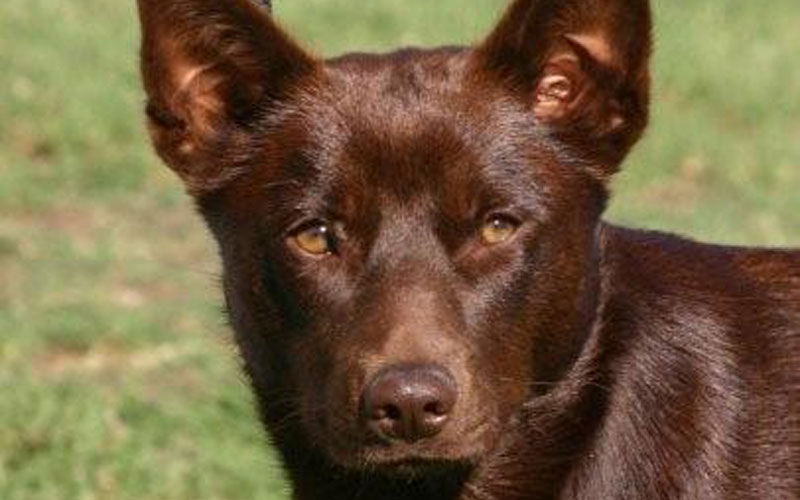
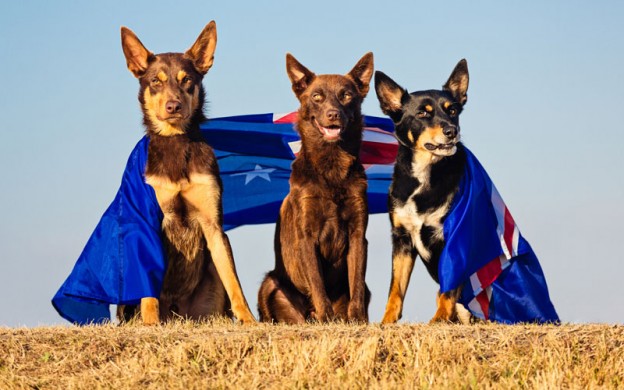
Many sheepdogs, including English North County Collies, were imported into Australia in the late 1800s. It’s thought that the Australian Kelpie we know today was developed from a smooth-coated black - and - tan Collie.
The Kelpie was originally used to herd Merino sheep on large sheep stations in the harsh Australian outback. The dogs had to be hardy and strong with weather-resistant coats, intelligent enough to work unsupervised, obedient, devoted and loyal. The Kelpie fitted the bill and today he’s just as popular in the show ring as he is in agility and obedience trials or on the farm.
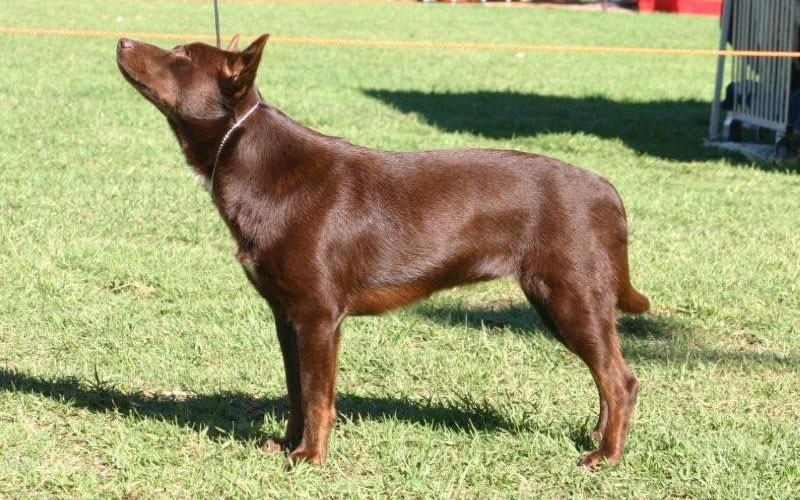
In appearance, the Kelpie gives the impression of a great worker, with his muscular condition and a tireless energy.
“The Australian Kelpie is the backbone of Australia,” says breed specialist judge Marie Colyer from Wingdari Kennels, NSW. Marie has been breeding the Australian Kelpie for 25 years and also handled Kelpies at the World Dog Show in Amsterdam in 2002.
“Kelpies need someone who is kind and gentle,” she says. “To be hard on a Kelpie would break his spirit. Even though he’s a working dog, given time, love and exercise, the Kelpie can make a wonderful family pet.”
The Kelpie is a highly intelligent and active dog that excels in agility and obedience. However, the breed doesn’t like being left alone for long periods in a backyard.
“A Kelpie needs mental stimulation more than physical,” says Marie. “Leaving a Kelpie in a backyard alone for extended periods without any love or care and not being part of your family is when you end up with a very disobedient and unhappy dog. The Kelpie needs to be part of your life,” she stresses. Kelpies are quick learners and very eager to please, but to be a happy well-rounded dog they must be included as part of the family.
“Kelpies are happy, outgoing, super-intelligent, sharp, swift and smart, with great endurance and dedication to their work and family,” says Marie.
“They have tunnel vision and have eyes for no one but their owners. They’re really renowned for that, so owners have to be consistent and firm with their training. But most of all they must be dedicated to giving mental stimulation rather than physical and this means making them part of the family.”
Like all breeds, Kelpies need basic obedience training but will catch on quickly and won’t take long performing everything you ask. “The Kelpie is very versatile,” Marie asserts. “In Sweden, Finland and Holland they’re used for search and rescue. In Australia they’re used in quarantine, agility, obedience, pets-as-therapy and, of course, herding sheep.”
Marie also enjoys watching her Kelpies’ funny antics. “I have an eight-year-old Kelpie named CJ (Clancy Junior) and ever since he was a puppy he has watched TV with us. When the RSPCA ad comes on, CJ immediately runs to the TV and waits for the wombat to appear. As soon as the wombat comes on he runs around the TV, crying and barking, looking for it. The minute the music stops he comes back and sits on his rug!” Fiona McGregor from Eurowenban Kennels in Dubbo, NSW and Christchurch, New Zealand has been breeding the Australian Kelpie for nearly 12 years. Fiona says the perfect person for the breed would be someone with regular time to spend with their dog and someone with a mildly active lifestyle. “You don’t need to run five kilometres a day — just some time for a walk or to play ball would be ideal,” she says.
Fiona also agrees that Kelpies love spending time with their family and make an ideal family companion. “My three children feed my dogs, are able to take food from them and have even sat in their whelping box with the mum and pups,” she says. “I’ve found that Kelpies are very intuitive towards children and people with disabilities.”
Because of the Kelpie’s loyalty and devotion to duty and family he can be very protective of his family and property — but, says Marie, “The Kelpie has a gentle and easygoing nature and will only ever attack if provoked.”
“Kelpies are often known as a one-person or one-family dog,” adds Fiona, “and for this reason they won’t normally run up to anyone for a pat. However there are exceptions.
“They’re not aggressive by nature in any way but can still be protective of their property or family. They make excellent watchdogs as they will bark when something is not right.”
The Kelpie is not only a great watchdog and family companion but his coat is very easy to maintain, as it’s moderately short, flat and straight with a short dense undercoat.
“Like all dogs they need a regular bath and a good brush at least twice a week,” says Marie, “but the Kelpie has an easy-care coat.”
Fiona agrees it’s an extremely low-maintenance breed. “Wash-and-wear, I call them,” she smiles.
The Kelpie is also a healthy breed with very few hereditary diseases. “People are now being more open in their discussion on hereditary diseases,”
Marie points out. “In some of the dogs that have been bred over the years, hip dysplasia (HD) has come up in some lines, as has progressive retinal atrophy (PRA), but these are being thoroughly researched by X-raying and other means.”
If you’d like to purchase an Australian Kelpie, please give the Australian Kelpie Puppy Liaison Officer a call on 0438 239 009 and they will be able to refer you to registered breeders. Says Marie, “On average, Kelpie pups cost from $500 upwards.” If you purchase a pedigree puppy from a registered breeder you will receive a registration certificate showing the pedigree of your puppy. The registration certificates are orange or blue. The orange certificate are for puppiess that can do agility, obedience or tracking or just as a pet. The blue certificate are for puppies that can be bred from or shown. Your puppy should be vaccinated, wormed and microchipped before leaving the breeders kennels. |